
From Change to Action: Rethinking Work and Business Value in the Age of AI
AI strategy is often split between two conversations.
Technology teams focus on pilots, platforms and deployment. People leaders focus on roles, skills and workforce planning.
But once AI enters real workflows, those decisions can no longer be separated.
That was the premise behind From Change to Action, GenAI Fund’s two part workshop series for HR, technology and business leaders. Held on 9 and 10 September 2026, the sessions explored two connected questions:
• How should organisations redesign work as AI takes on more tasks?
• How can leaders decide which AI initiatives to stop, prepare, pilot or scale?
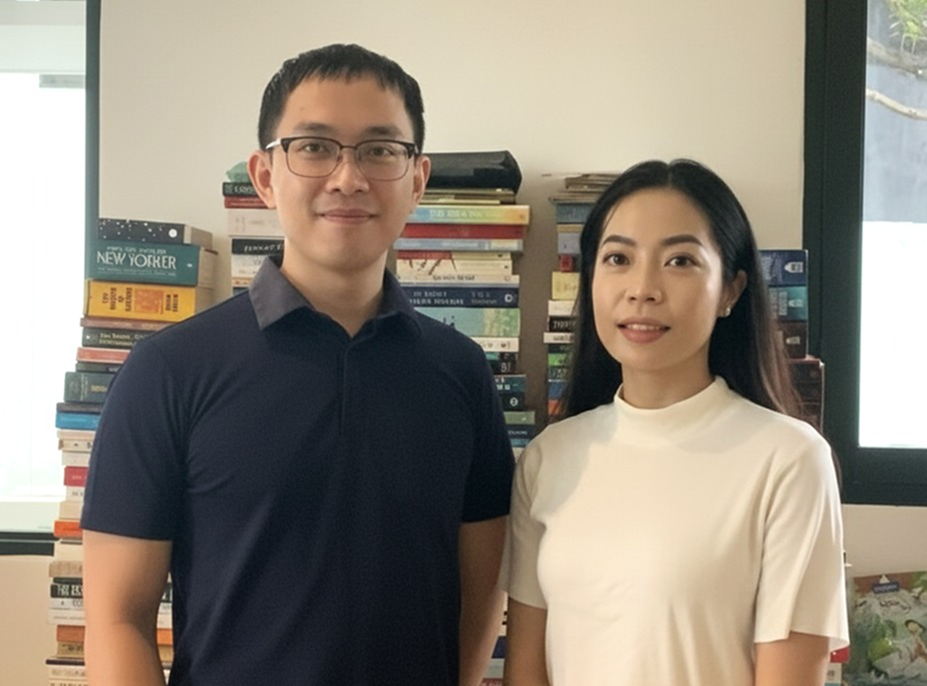
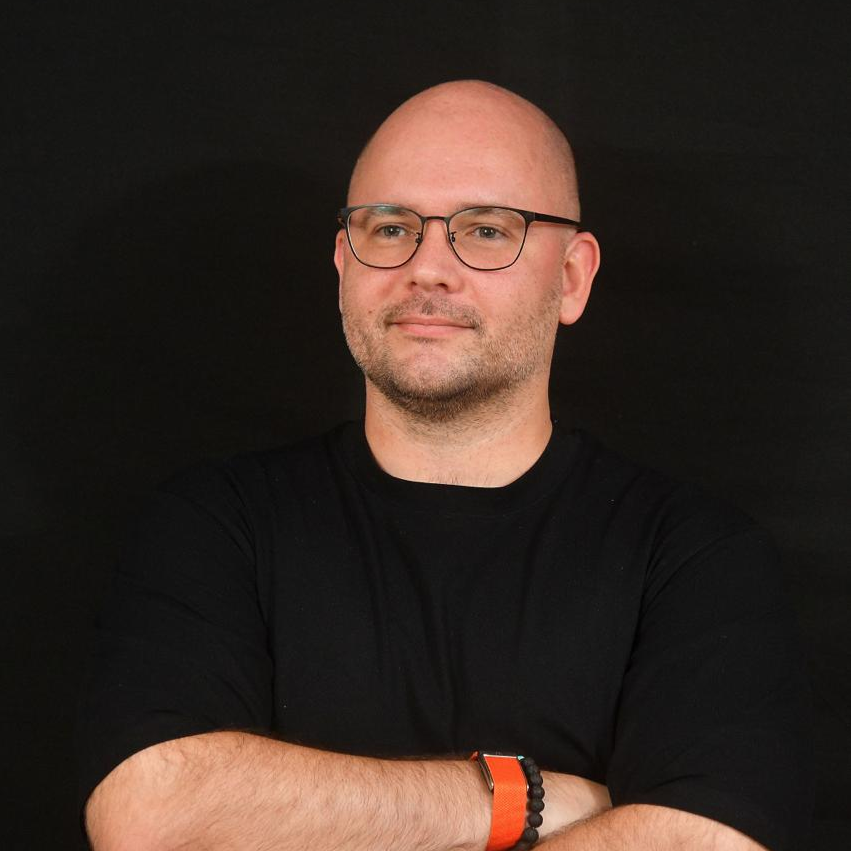
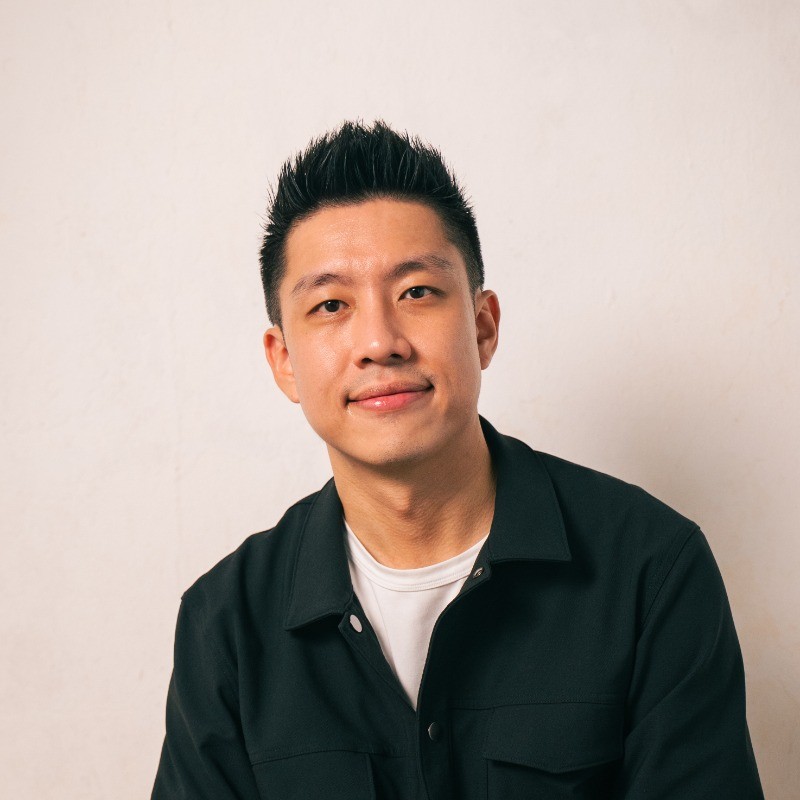
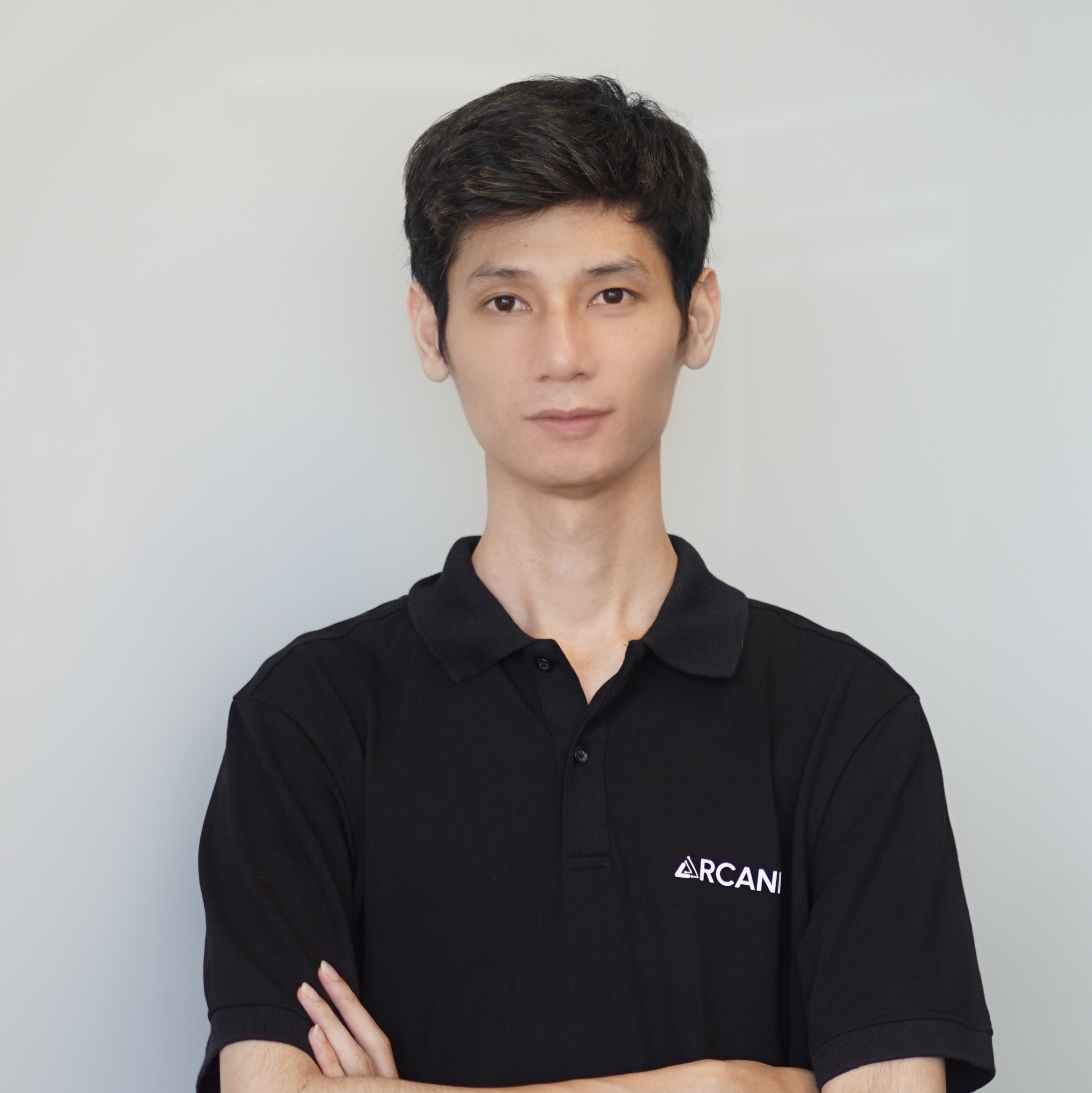
The discussions were led by Diana Gan, Lecturer at INSEAD and Asia School of Business and Executive Coach; Professor Michael Weihua Xu, Professor of Practice and DBAI Programme Director at The Hong Kong Polytechnic University; and Laura Nguyen, Managing Partner at GenAI Fund.
Workshop 1: The AI Workforce Shift
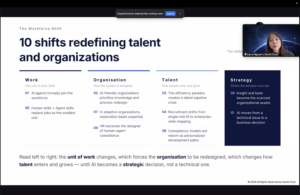
The first workshop examined how work is changing before most organisation charts do.
The central message was clear: workforce transformation should not begin with the question, “How many roles can AI replace?”
It should begin with the work itself.
What needs to be done? Which tasks are repeatable? Where is human judgement essential? What is the right combination of people, AI agents and software?
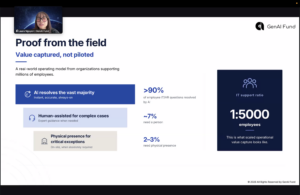
Laura shared observations from organisations in China where AI is already handling a large share of routine internal questions, including requests related to IT support, company policies and HR processes.
This does not remove people from the workflow. It changes where their time is most valuable. AI can respond to common questions, while employees focus on exceptions, sensitive situations and decisions that require context or judgement.
The same shift is beginning to affect onboarding. When AI can give new employees immediate access to policies, previous decisions, meeting records and project history, onboarding no longer needs to focus mainly on finding information. More time can be spent understanding the organisation’s culture, building relationships and learning how decisions are made.
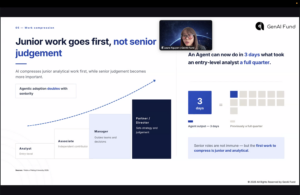
Diana also raised an important longer term risk. Many junior tasks are repetitive, but they are also how people learn. If organisations automate these tasks without creating new learning experiences, they may improve productivity now while weakening their future leadership pipeline.
The implication for HR leaders is that AI adoption requires more than training employees to use new tools. Organisations need to decide whether to:
🔄 Redesign the work and the workflow
📚 Reskill people for changing responsibilities
🔀 Redeploy talent into areas where demand is growing
🎯 Recruit when a capability cannot be developed internally
Hiring is only one option. The right response depends on how the work itself is changing.
🔗 When workforce and technology decisions converge
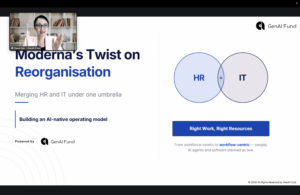
Diana used Moderna, the biotechnology company known for its mRNA vaccines, to illustrate how far this convergence can go.
Moderna brought responsibility for people and digital technology under one executive role. The significance is not simply that two functions now report to the same leader. It reflects a different way of thinking about organisational design.
Instead of HR planning the workforce while technology plans the systems, both can begin with the complete workflow. Leaders can then determine what people should own, what AI can support and what software should automate.
The Moderna structure is still relatively new, so it should not be treated as a model every company should copy. It does, however, show why workforce planning and technology strategy are becoming increasingly difficult to separate.
———————
Workshop 2: Beyond the Pilot
The second workshop moved from workforce redesign to enterprise execution.
Professor Michael Xu opened with a problem many organisations will recognise: a pilot can work and still be the wrong thing to scale.
A successful demonstration proves that a technology can perform a task. It does not automatically prove that the organisation has the data, ownership, processes, economics or governance required to create value from it.
Leaders therefore need to test a business capability, not only a technical feature.
Can the system perform an important workflow reliably? What does success look like? What are its limits? Who is accountable when it makes a decision? What business result should improve?
As Michael put it:
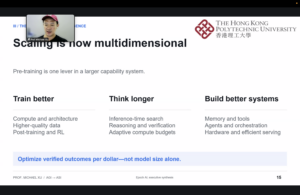
“Tokens are the meter. Outcomes are the product.”
Reducing the time required for a task is useful, but time saved is not yet business value. That capacity must be converted into something measurable, such as faster service, better decisions, fewer delays, improved quality or new revenue.
🧭 A clearer decision for every AI initiative
The workshop introduced a practical framework to help leaders determine what should happen next:
🛑 Stop when the problem is weak or the evidence does not support further investment
🧱 Prepare when the opportunity is credible but the data, skills or governance are not ready
🧪 Pilot when there is a clear hypothesis worth testing
📈 Scale only when both the technology and the operating model have been validated
This prevents organisations from accumulating disconnected pilots with no clear path forward.
It also brings discipline to the wider AI portfolio. Some initiatives should protect what already creates value. Others should transform existing operations. A smaller number may create an entirely new capability, product or business model.
💡 The shared lesson from both workshops
The two sessions addressed different audiences, but they arrived at the same conclusion.
AI adoption is not simply a technology programme. It is an operating model decision.
The organisations that move forward will not be the ones running the most pilots or deploying the most tools. They will be the ones that make deliberate choices about:
• Which workflows should change
• What people, AI agents and software should each handle
• How organisational knowledge is captured and made usable
• Which outcomes matter and how they will be measured
• Who owns the decision to stop, prepare, pilot or scale
✅ What leaders can do next
The best starting point is not a company wide transformation plan.
Choose two or three important workflows. Map how the work happens today. Identify where delays, handoffs or repetitive tasks are creating friction. Define the outcome that needs to improve, then test a different combination of people, AI agents and software.
At the same time, keep the internal conversation going. Workforce redesign rarely comes from a single meeting. Leaders need input from the people doing the work, the teams responsible for technology and the executives accountable for business results.
Small, well chosen experiments can reveal more than a long list of loosely connected AI initiatives.
———————
Continue the conversation
The From Change to Action workshop series is part of GenAI Fund’s work supporting organisations as they move from AI interest to practical adoption.
We support organisations through tailored AI training, study tours, internal hackathons and AI talent sourcing.
Explore our Corporate Innovation programmes
For a deeper conversation, please reach out to [email protected].